At the end of the 2012 tax year the Bush (or Obama) tax rates will increase to previous levels. Will the President and Congress act…
Taxpayers Could Face A Tax Increase As Congress Delays Vote On Taxes
shieldPeter Anderson
calendar_todayOct 08, 2010
updateUpdated Jun 15, 2026
schedule7 min read
verifiedFact-checked

We’ve written about the Bush tax cuts several times in the last few months, and how if Congress doesn’t act, the tax cuts will be expiring for everyone, not just the wealthy. While I still think it’s a remote possibility that the tax cuts won’t be renewed, and that congress will just blame it not being renewed on the other party, there is a more likely scenario. That the tax cuts could be renewed for everyone except high income earners, but that it won’t be renewed until the very last moment.
Bush Tax Cuts: To Be Renewed, But Not Until The Last Minute?
While I’ll be glad if the tax cuts do get renewed, they’re now saying in Washington that any more delays in renewing the tax cuts could result in some serious problems.
Lack of congressional action on 2011 income taxes may force the Treasury Department to make unprecedented moves to prevent U.S. workers from seeing large tax increases in their January paychecks. The issue: 2011 tax-withholding tables. Treasury officials usually release the tables, which determine the take-home pay of millions of wage-earners, by mid-November because it takes payroll processors weeks to adjust their systems before Jan. 1.
But congressional leaders recently postponed voting on taxes until after the election and lawmakers don’t reconvene until Nov. 15. The Senate is scheduled to take up several nontax issues when it returns and is expected to leave for Thanksgiving soon after, possibly pushing a vote on taxes into December.
“Things get very dicey after the first of December” because of employers’ need to know the 2011 rates, said Michael Graetz of Columbia University Law School, a former Treasury official.
Lawmakers’ recent track record on dealing with tax matters doesn’t inspire confidence that they will act with dispatch. Congress has yet to resolve the estate tax, which expired at the end of last year and is set to snap back to high rates come January. Nor has it tackled the alternative minimum tax for 2010, a levy that is set to hit 32 million taxpayers this year, compared with five million last year.
Some have suggested that if Congress doesn’t act in time, Treasury officials might consider a one- or two-month grace period in which it maintains current tables until Congress passes tax legislation. Capitol Hill tax staffers, meanwhile, say the Treasury could set 2011 withholding at current levels for joint filers earning less than $250,000 ($200,000 for single filers), on the assumption that Congress seems likely to enact this change.
Payroll Processors Need Time To Update Systems
Once again, Congress has dropped the ball. Their inaction means that payroll processors across the country are going to have a situation where they have to scramble to get their systems updated with new tax code – and since Congress has decided to kick the ball down the road until after the election (they don’t want to raise anybody’s taxes before the election), they’ll almost assuredly be putting the payroll processors in a pinch.
Payroll officials are “very concerned” about next year’s withholding, said Mr. Danilewicz, head of payroll at New York University’s Langone Medical Center, which has 15,000 employees. “It takes large employers three to four weeks to process and test these changes, and the government needs time before that to determine and publish them.”
He adds that large firms often run payrolls a week or two ahead of time, further pressuring the process.
A spokeswoman for Paychex Inc., which handles payroll for about 8 million employees of more than 500,000 small and midsize firms, said it takes two weeks to update systems properly.
A spokeswoman for Intuit Inc., which provides payroll programs to smaller firms, says it takes “fewer than 30 days” to incorporate withholding changes.
Treasury Not Sure What They Will Do
So basically at this point the payroll companies are left to guess what situation we’ll end up in, and the Treasury is now trying to figure out what they’ll do in anticipation of a possible change in tax law.
Treasury officials declined to discuss what they will do if lawmakers don’t come to a quick decision.
“The president and Secretary [Timothy] Geithner are confident Congress will vote to pass middle-class tax relief before the end of the year,” but Treasury “will maintain flexibility on the release of the withholding tables for 2011,” said a spokeswoman.
Any Treasury move to extend the status quo involves risks: If lawmakers don’t follow through, taxpayers could wind up owing big tax bills at the end of the year.
And such moves would be a radical departure from past practices, said Dennis Danilewicz, a recent president of the American Payroll Association who has done payroll work for three decades.
“I have never seen withholding tables based on assumptions about the law,” he said.
Treasury officials’ most obvious option is the least attractive. If they publish tables based on expiration of the Bush tax cuts, which occurs Jan. 1, millions of low- and middle-income taxpayers who have paid little or no income taxes for a decade would likely see increases in January. Prof. Graetz estimates that higher withholding could take up to $10 billion a month out workers’ pockets due to higher tax rates alone. Other benefits also are expiring.
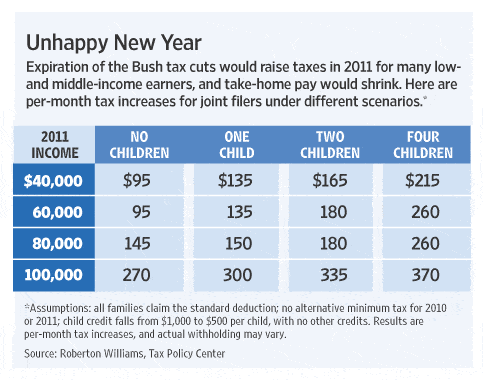
A childless couple earning $40,000, for example, could see their monthly take home pay shrink by about $100, according to the nonpartisan Tax Policy Center. If they had three children, they might face a further cut of $125 a month, said Scott Mezistrano, an official with the American Payroll Association. (See table.)
If paychecks get smaller, even temporarily, taxpayer reaction is likely to be intense.
It really is frustrating watching the political game as congress decides they would rather not allow any tax increases before the election because it might hurt their re-election chances. Hopefully people will take notice of their cynical game, and realize that increases for some are on the way, that payroll companies and possibly taxpayers will pay the price for their tom-foolery.
Even if Congress plans to extend current tax rates, it needs to do so quickly to avoid disruptions. There are enough differences between 2010 and 2011 numbers, such as inflation adjustments, that payroll executives still need weeks to update and test their systems.
“We need to get it right,” Mr. Danilewicz said. “Withholding is a sensitive subject, especially in a down economy when people live paycheck to paycheck.”
What do you think about the tax rates expiring, and Congress not taking action before the election. Is it just more of the same from Congress? Do you think they should be extended, or be allowed to expire? No matter how you feel about extending the tax cuts, wouldn’t it just be better to vote on it now to give the Treasury and others time to prepare? Tell us your thoughts in the comments.
Originally published at biblemoneymatters.com.
P
Written & reviewed by
Peter Anderson
Our editorial team researches and verifies every money-saving guide before publishing. Editorial policy · About us

